When you walk into any growing business today, you’ll notice one common thing- data is everywhere. The sales numbers, customer details, inventory updates, financial reports…everything is being tracked. But here’s the real question: Is all that actually helping in decision-making? In many cases, the answer is “no”.
That’s exactly why understanding How ERP and Business Intelligence Work Together to Drive Smarter Business Decisions matters more than ever. It’s not about collecting more data-it’s about finally making sense of it.
Where Do Most Businesses Get Stuck
Let’s be honest. Many companies invest in software, generate reports, and still end up making decisions based on assumptions.
Why?
Because the data sits in one place…and insights sit somewhere else- or worse, nowhere at all.
This gap is what slows down growth.
What ERP Really Does (Beyond the Basics)
An ERP system quietly runs in the background of a business, handling everything from billing and inventory to HR and purchasing. It records what’s happening across departments in a structured way.
So yes, ERP is powerful. But on its own, it mostly answers one thing:
“What is happening in the business?”
And that’s only half the story.
Now, This Is Where BI Steps In
You may wonder if there are plenty of MIS reports in ERP. Why BI?
While ERP systems generate plenty of MIS reports that help transactional and operational users monitor day‑to‑day activities, Business Intelligence serves a very different audience.
BI empowers managers, analysts, and decision‑makers by combining MIS with advanced analytics, data mining, and interactive visualizations to reveal patterns, predict trends, and guide strategic action.
In simple terms, MIS tells front‑line users what happened, whereas BI equips leadership with insights on why it happened and what should happen next, making it far more meaningful for enterprise‑wide, data‑driven decisions
Business Intelligence doesn’t collect data it also interprets it.
Instead of going through endless spreadsheets, BI tools present information in a way that actually makes sense. Think dashboards, trends, comparisons– things you can understand at a glance.
More importantly, BI helps answer questions like:
- Why are sales dropping in one region?
- Which products are actually driving profit?
- Where are we losing time or money?
- Which machines we need to replace instead of repeatedly servicing?
That’s when data starts becoming useful.
So, How Do They Work Together?
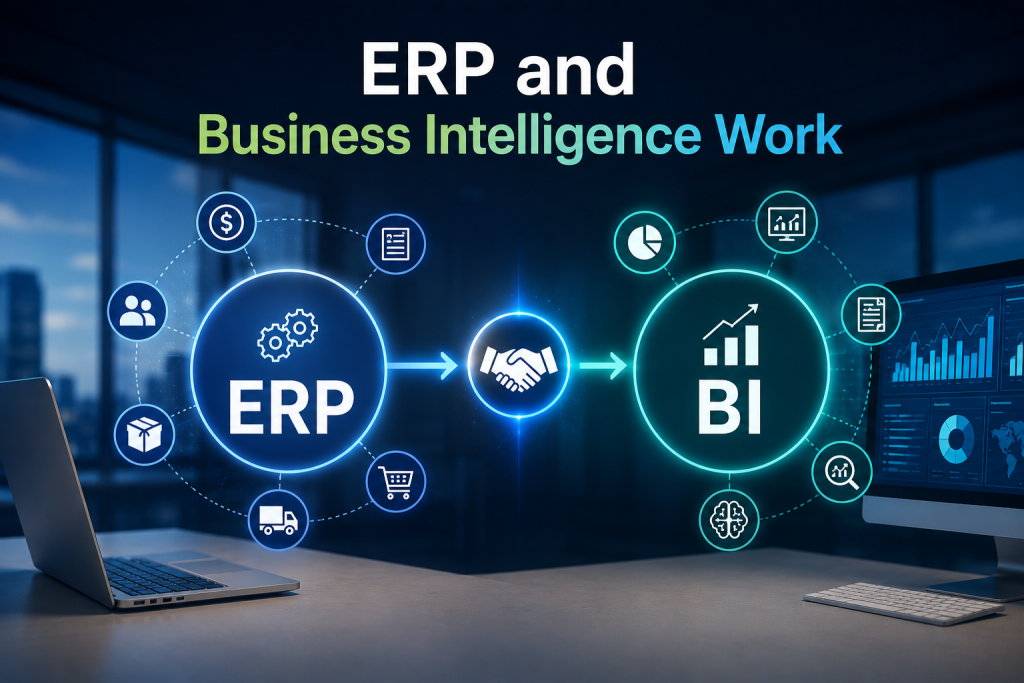
To really understand How ERP and Business Intelligence work together to Drive Smarter Business Decisions, think of it like this:
ERP is where your data lives.
BI is what brings that data to life.
ERP keeps feeding real-time business information, every sale, every update, every movement.
BI takes that flow of data and turns it into insights you can actually act on.
And once that connection is in place, things start to show the current scenario rather than the past.
What Changes When You Use Both Together?
You Stop Waiting for Reports
No more end-of-month surprises. You see what’s happening while it’s happening.
Decisions Become Less Stressful
When the numbers are clear, decision-making feels less like a guess and more like a strategy.
Problems Get Spotted Early
Whether it’s slow inventory movement or declining sales, you catch issues early
Instead of reacting late.
Planning Becomes Smarter
You’re not just looking at past data; you’re preparing for what’s coming next.
Customers Get Better Experiences.
When you understand behaviour and trends, you naturally serve customers better. And that builds loyalty.
Put together, these are the ones that make you more competitive in the dynamic market conditions.
Why More Businesses Are Moving This Way
Managing operations and analyzing performance separately just doesn’t work anymore. It creates delays, confusion, and sometimes wrong decisions.
That’s why many businesses are now choosing integrated solutions offered by an ERP Company in Chennai that combines both ERP and BI in one system.
With this approach, everything stays connected. No duplication. No mismatched data. Just one clear view of the business.
In fact, several ERP companies in Chennai are focusing on building smarter systems that don’t just manage work, but actually guide decisions, the reason why Chennai is figuring as one of the world class manufacturing hubs in India.
Choosing the Right ERP Partner Matters
Here’s something people often overlook: the software is important, but the partner you choose matters just as much.
A good ERP Company in Chennai won’t just install a system and leave. They’ll understand how your business works and shape the solution around it.
Look for a partner who:
- Have great success stories
- Long term player
- Understands your industry
- Offers clear, simple dashboards
- Helps your team actually use the system
- Says available for support when needed
Because at the end of the day, a system’s only useful if people can rely on it.
Conclusion
ERP keeps your business organized. Business intelligence helps you understand what all that information actually means. Put them together, and you get something much more valuable, a system that supports real, confident decision-making. And that’s the core of How ERP and Business Intelligence Work Together to Drive Smarter Business Decisions, not just managing operations but making better choices every single day. With Business Intelligence, you gain competitive advantage.
Ready to Make Smarter Decisions?
If you’re looking to bring clarity into your business and turn your data into real results, it’s time to take the next step.
Visit our website, AmitySoft, to explore how the right ERP solution can transform your business. For more details or personalized guidance, feel free to contact us- we’re here to help you move forward with confidence.