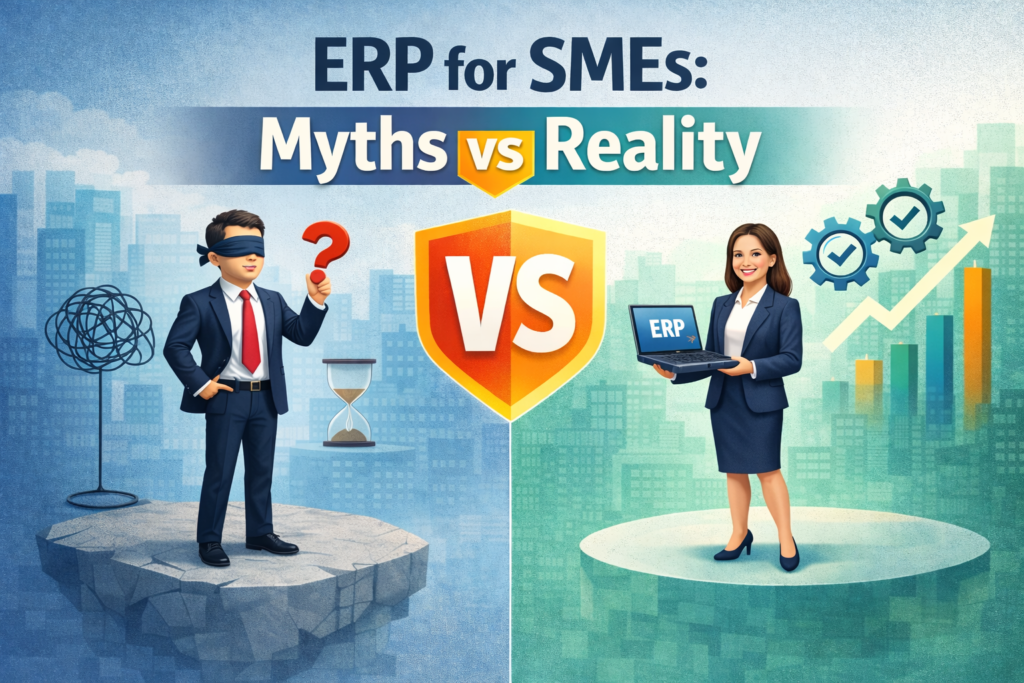
 Many small and medium-sized enterprises (SMEs) still believe that ERP software is complicated, expensive, and meant only for large corporations. They often manage with simple accounting software and a set of spread-sheets. As a result, ERP adoption is often delayed, even when businesses struggle with disconnected systems, manual work, and limited visibility.
The truth is very different.
Modern ERP solutions are built with SMEs in mind. Let’s clear the air by addressing the most common myths about ERP for SMEs and understanding the reality behind them.
Myth 1: ERP Software Is Only for Large Enterprises
Reality: ERP is now designed for businesses of all sizes.
Earlier, ERP systems were complex and resource-heavy, making them suitable mainly for large organizations. Today, ERP software is modular and scalable. SMEs can choose only the modules they need—such as financials, inventory, HR, or payroll—and expand later as their business grows. Even within a module such as Financials, the enterprise can choose to deploy sub-modules such as fixed assets, loans & investments etc., progressively.
ERP has become a growth tool, not a corporate luxury.
Myth 2: ERP Is Too Expensive for Small Businesses
Reality: ERP is more affordable than most SMEs expect.
With the rise of cloud-based ERP solutions, businesses no longer need to invest heavily in servers or IT infrastructure. Subscription-based pricing allows SMEs to pay monthly or annually, making ERP a manageable operational expense rather than a large capital investment. They can start with a small number of users to reduce the subscription cost and increase the count as the organization and the need grows.
In many cases, ERP actually reduces overall costs by eliminating inefficiencies, manual errors, and data duplication.
Myth 3: ERP Implementation Takes Too Long
Reality: ERP implementation can be quick and structured.
For SMEs, ERP implementation is typically much faster than for large enterprises. Since business processes are simpler and require fewer customizations, implementation can be completed in weeks or a few months. ERP provide features for users to configure reports as and when required which eliminates need for external support when the organization’s reporting needs grow.
Many companies choose a phased rollout—starting with core modules like finance or inventory—ensuring smooth adoption with minimal disruption.
Myth 4: ERP Systems Are Difficult for Employees to Use
Reality: Modern ERP systems are user-friendly.
Today’s ERP platforms focus heavily on usability. Clean interfaces, role-based dashboards, and automated workflows make daily tasks easier for employees. With basic training, teams often adapt quickly and prefer ERP over spreadsheets and manual records. With simpler user interfaces including voice interface using an ERP has become more simpler.
ERP simplifies work—it doesn’t complicate it.
Myth 5: SMEs Don’t Have Enough Data for ERP
Reality: ERP helps SMEs organize and manage data effectively.
ERP doesn’t require large volumes of historical data. Instead, it creates a structured system where data is captured accurately from the start. Over time, ERP becomes a centralized database for sales, finance, HR, and operations—supporting better planning and informed decision-making. In a competitive scenario analytical insight is important for strategy and growth which comes out the end to end data captured by ERP.
Myth 6: ERP Reduces Business Flexibility
Reality: ERP increases control and agility.
ERP gives business owners real-time visibility into every part of the organization. From tracking inventory levels to monitoring cash flow, ERP enables faster and smarter decisions.
With the advent of Artificial Intelligence, ERPs with AI agents can provide several benefits to SMEs.
With cloud ERP, business data can be accessed securely from anywhere, allowing SMEs to stay agile in a competitive market.
Why ERP Makes Sense for SMEs
When implemented correctly, ERP software delivers long-term value for SMEs:
- Centralized business information
- Improved operational efficiency
- Better financial accuracy and compliance
- Reduced manual work and errors
- Scalable systems that grow with the business
- Data-driven decision-making
- Adoption of AI for productivity and innovation
Final Thoughts
ERP software is no longer out of reach for small and medium-sized enterprises. It has evolved into a practical, affordable, and powerful solution that supports growth and stability.
By moving past outdated myths and understanding the real benefits, SMEs can confidently adopt ERP as a foundation for digital transformation with AI.