 An ERP project can look successful on paper.
The software has been purchased. The implementation team has been assigned. Employees have attended a few training sessions. The launch date is fixed.
And then the system goes live.
Suddenly, reports don’t match. Employees are unsure which process to follow. Old data contains errors. Some departments continue using spreadsheets because they don’t trust the new system. Management starts asking a difficult question:
“Where did the implementation go wrong?”
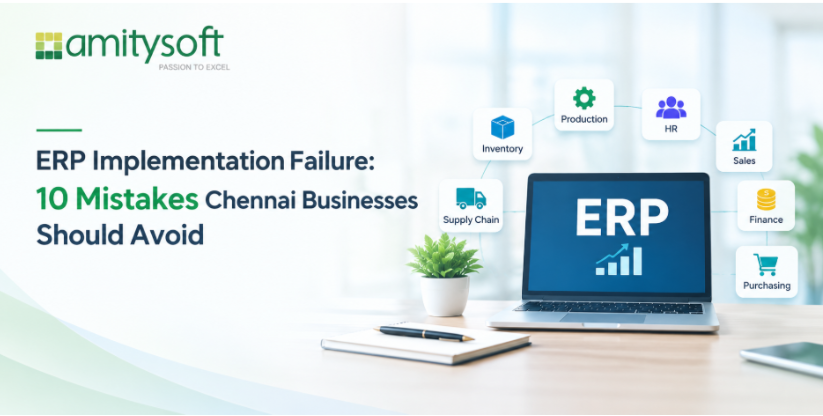
ERP implementation failure rarely happens because the software simply “doesn’t work.” More often, the problem begins much earlier with unclear requirements, poor planning, weak communication, or choosing the wrong implementation approach.
For Chennai businesses, where manufacturing, engineering, automotive, trading, logistics, and service companies operate, an ERP system has to fit the way the business actually works. Choosing an ERP product vendor is therefore only one part of the decision. How the implementation is planned and executed matters much more.
Here are 10 mistakes businesses should watch out for.
1. Starting the Project Without Knowing What Needs to Change
An ERP project should not begin with the question, “Which software should we buy?”
It should begin with:
“What problems and pain points are we trying to address?”
Maybe inventory information is always delayed. Perhaps purchase approvals take too long. Maybe finance and sales teams maintain different versions of the same information.
These problems should be identified before selecting or configuring an ERP system.
Without this clarity, the project can turn into a software installation exercise rather than a genuine business improvement project.
2. Choosing ERP Software Before Understanding Business Requirements
A system may look impressive during a product demonstration. The screens are attractive, the features sound useful, and the sales presentation is convincing.
But does it actually suit your business?
A manufacturing company, distributor, service organization, and project-based business can have very different requirements.
Prior to selecting ERP Software in Chennai, businesses should map their important workflows. Look at purchasing, sales, production, inventory, finance, approvals, reporting and other areas that affect everyday operations.
The right ERP should fit the business—not force the business into an unsuitable process.
3. Leaving Senior Management Out of the Project
ERP affects more than the IT department.
Finance, production, purchasing, sales, HR, and management may all depend on the system. Naturally, different teams can have different priorities.
This is where leadership becomes important.
When there is a disagreement about processes, priorities, or timelines, someone needs the authority to make the final decision. Without an executive sponsor, small issues can remain unresolved and eventually affect the entire project.
Management doesn’t have to handle technical work. But management must be part of the steering committee and take important decisions.
4. Treating Data Migration Like a Simple Copy-and-Paste Job
This is one of the mistakes that often gets noticed only after implementation.
Businesses may have years of customer records, supplier details, product codes, stock information, and financial data sitting in different systems or spreadsheets.
Moving all of it into a new ERP does not automatically make it ready.
Duplicate customers, incorrect item codes, outdated records, and inconsistent formats can create problems later.
Before migration, businesses should review the data, remove unnecessary records, standardize important fields, and verify critical information.
A new ERP cannot fix bad data simply because the data has been moved into better software.
5. Assuming Employees Will Automatically Accept the New System
This is a very common mistake.
Management may see the ERP as an improvement. Employees may see it as another system they have to learn while already managing their daily workload.
Both perspectives are understandable.
People are more likely to accept a new ERP when they understand why the change is happening and how it will make their work easier.
Training should therefore begin at the earliest, identifying different roles and visualising potential ERP scenarios. More importantly, users from different departments should have a voice during the implementation process.
The people who use the ERP every day often know practical problems that may not appear in a project document.
6. Rushing Through Testing to Meet the Launch Date
A launch date is useful for keeping a project moving.
But meeting the date should not become more important than making sure the system works.
End to end ERP testing should involve actual business situations.
For example, don’t simply check whether a sales invoice can be generated. Test a complete flow from quotation to order, stock availability, dispatch, invoicing, and accounting.
The same approach should be followed for purchasing, production, inventory, and other important processes.
Finding a problem before go-live is an inconvenience.
Finding it after go-live can become an operational problem.
7. Customizing Everything Instead of Improving the Process
Businesses naturally want their new ERP to behave exactly like their old system.
But that can defeat the purpose of implementing new technology.
If every old process is recreated through customization, the company may end up with a complicated system that is expensive to maintain and difficult to upgrade.
Not every existing process is necessarily the best process. The purpose of choosing an ERP product will be defeated by incorporating a lot of customizations leading to chaos.
During implementation, teams should ask a simple question:
“Do we really need this customization, or are we simply used to doing things this way?”
Some customization may be necessary. The key is knowing where to draw the line.
8. Setting a Timeline That Looks Good on Paper
ERP implementation involves requirements, configuration, data preparation, integrations, testing, training, and user acceptance.
That takes time.
A company that expects a complex implementation to be completed unrealistically quickly may create pressure across every stage of the project.
Then corners get cut.
Training becomes shorter. Testing is reduced. Data checking is rushed.
A realistic timeline may take longer at the beginning, but it can prevent much bigger problems later. Periodic progress review should refine the schedules in agreement with all stake holders.
For Chennai businesses working across multiple departments, branches, or production units, implementation planning should account for the actual complexity of the organization.
9. Selecting an Implementation Partner Based Only on Price
Cost matters. But choosing an ERP partner only because the quotation is lower can become expensive later.
The implementation partner should understand your industry, workflows and business priorities.
When evaluating an ERP company in Chennai, businesses should look beyond the initial proposal.
Ask:
- Have they implemented ERP for businesses similar to yours?
- Do they understand your industry processes?
- Who will handle the implementation?
- What happens when users face problems after launch?
- How will training and support be handled?
- What sort of experience does the implementation team possess?
A good implementation partner doesn’t simply deliver software. They help the organization transition to a better way of working.
10. Thinking the ERP Project Ends at Go-Live
This is perhaps the biggest misconception.
Go-live is not the finish line.
It is the point at which employees begin using the system in real business conditions. New questions will appear. Users will need help. Some reports may need adjustments. Certain workflows may need refinement.
That is normal.
A reliable ERP software implementation in Chennai should include hyper care and post-go-live support.
The objective should not be simply to launch the system. The objective should be to make sure the business actually gets value from it.
A Simple Question to Ask Before You Start
Before investing in an ERP system, bring the key people in your organization into one room and ask:
“What should become easier after we implement ERP?”
The answers can reveal a lot.
If the finance team wants better compliance, the production team wants better planning, the purchasing team wants better supplier visibility, and management wants one reliable view of the business, those requirements should shape the implementation.
That is far more useful than starting with a list of software features.
Conclusion
ERP implementation is a major business decision with a lot of investment and hopes on returns on investment.
Most implementation problems can be reduced when businesses spend enough time understanding their requirements, preparing their data, involving all stake holders, testing real workflows, and choosing the right implementation partner.
For companies looking for ERP Software in Chennai, the goal should not be to find the software with the longest list of features. The better question is whether the solution and implementation approach can genuinely solve the problems your business faces.
Choosing the right ERP company in Chennai can make that journey considerably smoother by bringing the right combination of technology, industry understanding, and implementation experience.
If your business is planning an ERP implementation and wants to understand the right approach, visit AmitySoft to explore its ERP solutions and services. For further enquiries or to discuss your business requirements, contact the AmitySoft team and take the first step toward a more connected and efficient business operation.